Manufacturing & Production
Downtime, OEE, capacity, scheduling, labour recovery, overtime, bottlenecks, quality, rework, scrap and production control.
About the model
The operator responding to the requirement brings whole-business capability into the work itself: across trades, manufacturing, projects, people, supply chain, commercial performance and general management.
The operating perspective
The perspective behind SolidSimple was built close to the work: across trades, production, project delivery, engineering interfaces, people, distribution and supply chain before carrying broader operational, commercial and general-management responsibility.
It includes the less visible work of running a business: contracts, invoicing, budgets, statutory administration, staffing, performance, culture and the relationships that keep delivery moving.
It also includes leading operations through formal restructuring, working alongside owners and appointed professional advisers while protecting continuity, staff alignment, supplier confidence and the decisions required for recovery.
That breadth creates a practical view of a business. Strategy has to survive contact with the floor. Systems have to work for the people using them. Commercial decisions have to translate into capacity, behaviour, delivery and margin.
The operator who responds to the requirement does not sit on the sidelines or hand delivery to a junior consultant. They get inside the operation, work through the problem with your people and remain responsible for leading the engagement.
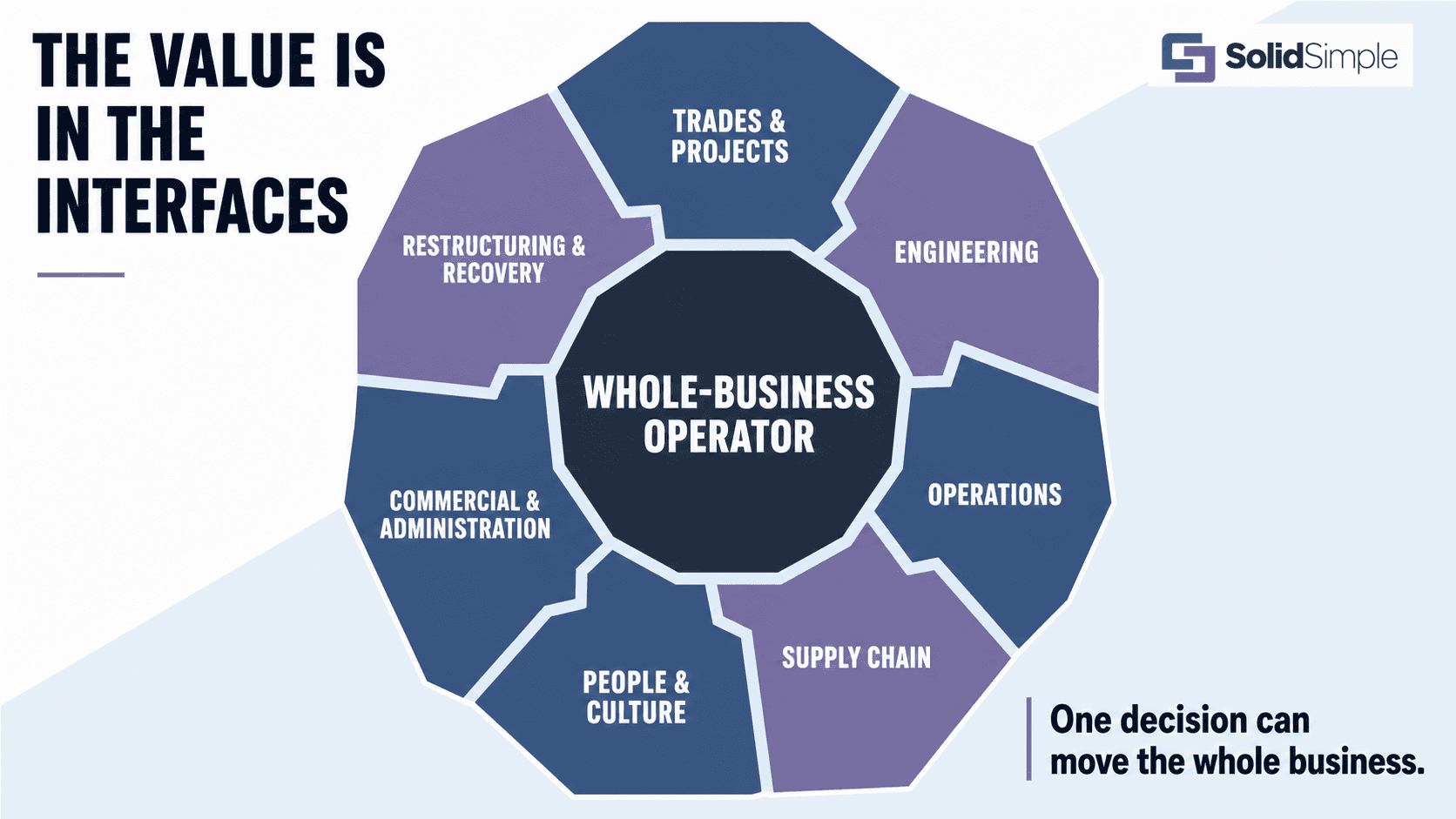
Where operating responsibility can sit
These are not separate advisory service lines. They are parts of the operation in which SolidSimple can take a defined mandate, strengthen a function or connect the interfaces preventing the business from performing as one system.
Downtime, OEE, capacity, scheduling, labour recovery, overtime, bottlenecks, quality, rework, scrap and production control.
Workforce planning, recruitment, onboarding, role clarity, accountability, performance management, frontline leadership, culture and change support.
Purchasing controls, sourcing, supplier negotiations, commercial and trading terms, contract administration, spend analysis, tendering, supplier risk and make-or-buy decisions. Legal advice is used where required.
Inventory, warehousing, freight, carrier performance, dispatch, DIFOT, stock accuracy, vehicle utilisation, returns and cost-to-serve.
Risk assessments, incident investigation, corrective actions, SOPs, contractor safety, traffic management, safety leadership and operational risk controls.
Kaizen, 5S, standard work, Kanban, value-stream mapping, waste removal, root-cause analysis, visual management and continuous-improvement implementation.
P&L analysis, margin leakage, job and project profitability, labour recovery, working capital, WIP, cash conversion, cost structure, operational forecasting, OPEX, CAPEX support and pricing inputs.
Estimating handover, mobilisation, labour allocation, subcontractors, procurement, variations, progress claims, project cash flow, defects, closeout and pipeline-versus-capacity planning.
KPIs, dashboards, reporting, management rhythms, accountability, SOPs, workflow, ERP utilisation, operating controls and multi-site standardisation.
Cash-flow pressure, creditors, ATO exposure, supplier pressure, operational continuity, critical suppliers, staff stability, immediate priorities and the operational implications of informal restructuring, SBR or voluntary administration, working alongside appointed legal, accounting and insolvency advisers.
The operating philosophy
Start with what is actually happening in the operation, not what the process map or management report says should be happening.
Align responsibility, behaviour and management rhythm so the systems already inside the business can produce a result.
Connect operational improvement to margin, cash, capacity, risk and the ability to deliver consistently.
Infrastructure in its proper place
The SolidSimple Operating Centre gives the work continuity and gives clients a clear view of their engagement. It exists to reduce administrative friction and improve owner and leadership visibility, not to replace judgement, relationships or accountability.
Australia-wide capability
Initial engagements are focused on Brisbane and South East Queensland, allowing meaningful on-site involvement where required.
Elsewhere in Australia, the operating responsibility and on-site rhythm are agreed around the actual requirement, using travel and remote oversight where they support the work rather than substitute for it.
A different kind of leadership engagement
If the business needs experienced judgement followed through into visible execution, start with the capability gap and the operating requirement.